
 By admin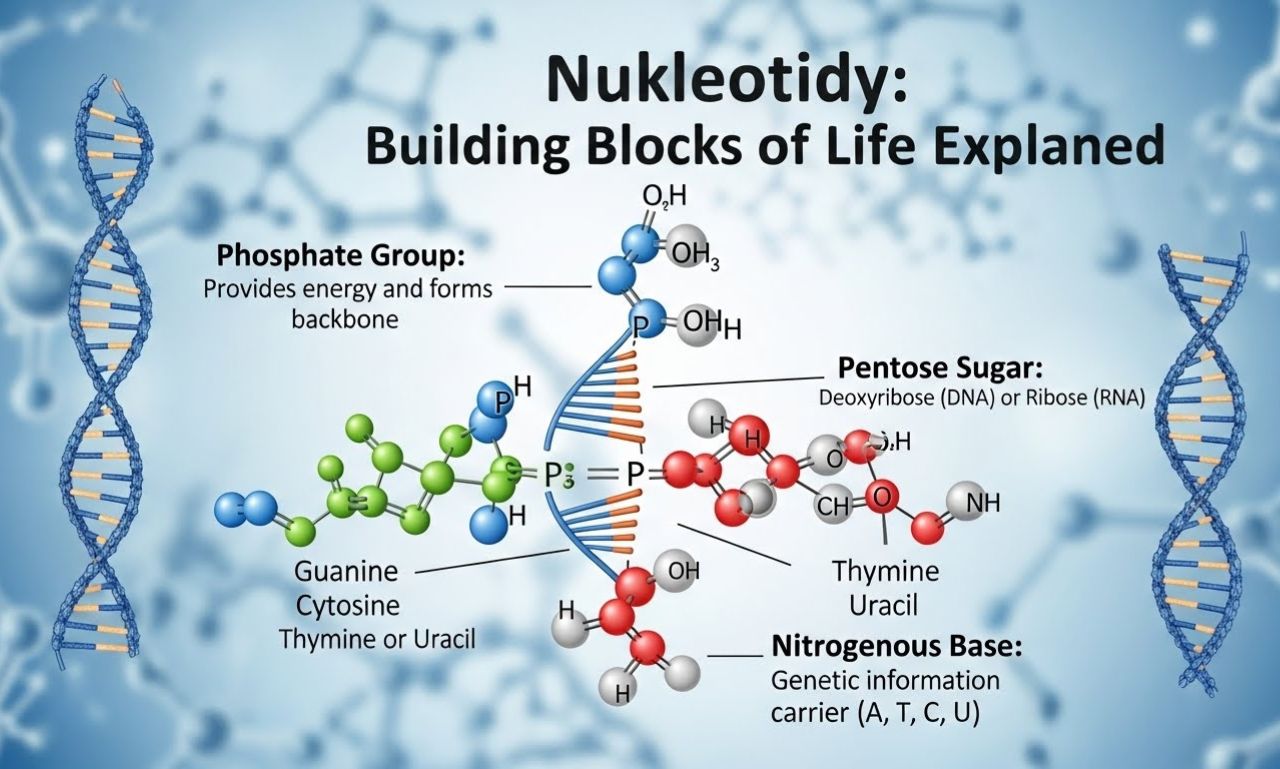
In modern biology and biochemistry, few molecules are as essential as Nukleotidy. At the most fundamental level, these tiny yet powerful compounds form the structural and functional backbone of genetic material and also play a vital role in energy transfer, cellular communication, and metabolism. From one perspective, they determine inherited traits, while at the same time, they support everyday cellular activities. For these reasons, Nukleotidy are truly fundamental to life itself.
In this article, we explore Nukleotidy in depth, beginning with their structure and types and then moving on to their biological roles and growing importance in health, nutrition, and scientific research. By doing so, we gain a clearer picture of how life functions at its most basic level. Overall, understanding these molecules helps bridge the gap between molecular science and living systems.
What Are Nukleotidy?
Nukleotidy are organic molecules that serve as the basic units of nucleic acids. They are the building blocks of DNA (deoxyribonucleic acid) and RNA (ribonucleic acidAthena Health Login: A Step-by-Step Guide for New Users), which store and transmit genetic information in all living organisms.
Each nucleotide consists of three key components:
-
A nitrogenous base
-
A five-carbon sugar
-
One or more phosphate groups
When these components join together, they form a molecule capable of linking with others to create long chains. These chains encode genetic instructions and regulate countless biological processes.
Chemical Structure of Nukleotidy
Understanding the structure of Nukleotidy helps explain their versatility. Although they may appear simple, their design allows for remarkable complexity and precision.
Nitrogenous Bases
The nitrogenous base determines the identity of the nucleotide. These bases fall into two groups:
-
Purines: Adenine (A) and Guanine (G)
-
Pyrimidines: Cytosine (C), Thymine (T), and Uracil (U)
DNA uses A, G, C, and T, while RNA uses A, G, C, and U.
Sugar Component
The sugar molecule connects the base to the phosphate group. DNA contains deoxyribose, whereas RNA contains ribose. This small structural difference has a significant impact on stability and function.
Phosphate Group
The phosphate group enables nucleotides to link together. It also plays a critical role in energy storage and transfer, especially in molecules like ATP.
Types of Nukleotidy in Biological Systems
Nukleotidy can be classified based on their function and location within the cell. Each type contributes uniquely to life processes.
DNA Nucleotides
These nucleotides form DNA, the molecule responsible for storing genetic instructions. The specific sequence of DNA nucleotides determines traits such as eye color, metabolism, and susceptibility to certain diseases.
RNA Nucleotides
RNA nucleotides help convert genetic information into proteins. Messenger RNA, transfer RNA, and ribosomal RNA each rely on specific nucleotide sequences to perform their roles accurately.
Energy-Carrying Nukleotidy
Some nucleotides are central to cellular energy. Adenosine triphosphate (ATP) acts as the primary energy currency of the cell, powering muscle contraction, nerve signaling, and chemical synthesis.
Biological Functions of Nukleotidy
The importance of Nukleotidy extends far beyond genetics. Their functions influence nearly every aspect of cellular life.
Genetic Information Storage
DNA nucleotides store hereditary information in a stable and organized form. This information is passed from one generation to the next, ensuring continuity of life.
Protein Synthesis
RNA nucleotides guide the assembly of amino acids into proteins. Without this process, cells would be unable to repair themselves or perform specialized functions.
Energy Transfer
Energy-rich nucleotides allow cells to store and release energy as needed. This process supports growth, movement, and metabolic balance.
Cellular Signaling
Certain nucleotides act as signaling molecules, helping cells communicate with one another. This communication is essential for coordinating responses to environmental changes.
Nukleotidy and Human Health
In recent years, scientists have discovered that Nukleotidy play an important role in maintaining human health. Although the body can produce many nucleotides on its own, dietary intake may become important during periods of rapid growth, illness, or stress.
Immune System Support
Nucleotides contribute to the development and function of immune cells. Adequate levels may help the body respond more effectively to infections.
Digestive Health
Some studies suggest that dietary nucleotides support intestinal cell growth and repair. This is particularly relevant for infants and individuals recovering from gastrointestinal disorders.
Brain and Cognitive Function
Nucleotides are involved in neurotransmitter production and nerve cell maintenance. As a result, they may influence memory, learning, and overall brain health.
Dietary Sources of Nukleotidy
While the body can synthesize nucleotides, certain foods naturally contain them and can contribute to overall intake.
Common dietary sources include:
-
Meat and poultry
-
Fish and seafood
-
Legumes and beans
-
Whole grains
-
Dairy products
Breast milk is also rich in nucleotides, highlighting their importance during early development.
Role of Nukleotidy in Modern Research
Scientific interest in Nukleotidy continues to grow. Researchers are exploring their potential applications in medicine, biotechnology, and nutrition.
Genetic Engineering
Nucleotides are essential tools in genetic research. Techniques such as DNA sequencing, gene editing, and molecular diagnostics rely heavily on precise nucleotide manipulation.
Pharmaceutical Development
Many antiviral and anticancer drugs are designed to mimic or interfere with nucleotide metabolism. These treatments target rapidly dividing cells or viral replication processes.
Nutritional Science
Supplementation with nucleotides is being studied for its potential benefits in infant nutrition, sports recovery, and immune support.
Nukleotidy in Biotechnology and Industry
Beyond medicine, Nukleotidy have found applications in various industrial fields.
In biotechnology, synthetic nucleotides are used to design vaccines, develop diagnostic kits, and create genetically modified organisms for agriculture. In the food industry, they are sometimes added as flavor enhancers due to their ability to boost umami taste.
Differences Between Nukleotidy and Nucleosides
It is important not to confuse nucleotides with nucleosides. While closely related, they differ in structure and function.
-
Nucleosides consist of a nitrogenous base and a sugar.
-
Nukleotidy include an additional phosphate group.
This phosphate group gives nucleotides their unique ability to store energy and form long chains.
Evolutionary Importance of Nukleotidy
From an evolutionary perspective, Nukleotidy have enabled life to adapt and diversify. Mutations in nucleotide sequences introduce genetic variation, which drives evolution through natural selection.
Over billions of years, these small molecular changes have led to the vast diversity of life seen on Earth today.
Future Perspectives on Nukleotidy
As science advances, the significance of Nukleotidy is expected to grow even further. Emerging fields such as synthetic biology and personalized medicine rely heavily on understanding and manipulating nucleotide sequences.
In the future, nucleotide-based therapies may offer targeted treatments for genetic disorders, cancers, and immune-related diseases. Additionally, advances in nutrition science may lead to personalized dietary recommendations based on nucleotide metabolism.
Conclusion
Nukleotidy are far more than simple molecular units. They are the foundation of genetic information, the drivers of cellular energy, and key players in communication within and between cells. Their influence spans biology, medicine, nutrition, and biotechnology, making them indispensable to both life and scientific progress.
By understanding Nukleotidy, we gain insight into how living systems function, adapt, and evolve. As research continues, these remarkable molecules will undoubtedly remain at the center of innovation and discovery, shaping the future of science and human health.